

Table of Contents
Executive Summary
The Traditional Trade Landscape
Historical Challenges
The Modernization Revolution
Measurable Results
Implementation Framework
Future Outlook
Executive Summary
While headlines focus on e-commerce growth and modern retail expansion, the GCC's traditional trade channel- comprising hundreds of thousands of independent grocers, bakala shops, and small-format retailers- remains a critical distribution channel accounting for 30-45% of FMCG sales across the region.
This white paper examines how forward-thinking brands and distributors are modernizing traditional trade through digital tools, data analytics, and reimagined route-to-market strategies, unlocking growth and profitability in a historically challenging channel.

The Traditional Trade Landscape
Traditional trade in the GCC encompasses diverse formats, each serving distinct consumer needs and communities across the region:
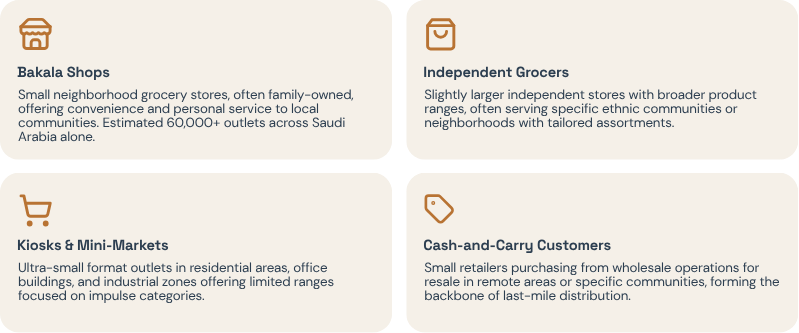
Despite modern retail's expansion, traditional trade persists due to several structural advantages that continue to resonate with consumers:
1. Proximity
Neighborhood locations within walking distance of consumers, particularly important in areas with limited modern retail access.
2. Convenience
Longer operating hours (many open until midnight or operate 24/7), quick shopping trips, no parking hassles.
3. Personal Relationships
Shopkeepers knowing customers by name, extending informal credit, providing recommendations based on personal knowledge.
4. Cultural Comfort
Familiar environments where traditional shopping behaviors feel natural, particularly for older consumers and certain ethnic communities.
5. Price Flexibility
Negotiation possibilities and informal discounts not available in modern retail’s fixed-price environments.
Historical Challenges
Traditional trade has historically frustrated brand manufacturers due to systemic challenges across visibility, execution, standards, and financial management.
Limited Visibility
Brands lack real-time insight into what’s actually happening across thousands of dispersed outlets. This visibility gap means brands invest in distribution without knowing if products actually reach shelves in sellable condition or at appropriate prices.
Inefficient Execution
Traditional route-to-market involves significant operational inefficiencies that compound across large networks:
1. Fixed Route Visits
Sales representatives visiting stores on fixed routes regardless of actual needs, wasting time on stores that don’t require attention.
2. Manual Order-Taking
Paper forms prone to errors, illegible handwriting, and missing information leading to incorrect deliveries and customer dissatisfaction.
3. Delayed Processing
Orders submitted at day’s end, processed overnight, delivered days later—creating stock-out windows and lost sales opportunities.
4. Low Productivity
Limited sales representative productivity of only 8-12 stores visited daily, with significant time lost to travel, paperwork, and administrative tasks.
5. Administrative Burden
High overhead from manual reporting, reconciliation, and data entry that diverts resources from value-creating activities.
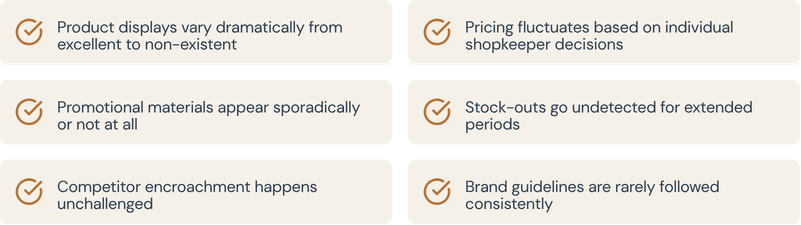
Inconsistent Standards
Without systematic monitoring, execution quality varies dramatically across the traditional trade network:

The Modernization Revolution
In recent years, innovative distributors and brands have reimagined traditional trade through technology and operational excellence. The modernization revolution addresses each historical challenge with targeted digital solutions.
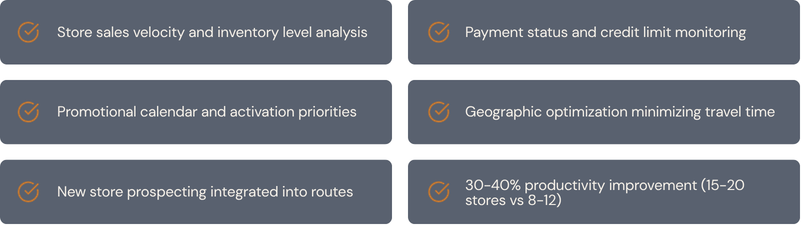
Digital Route Management
Mobile applications now enable intelligent, data-driven route management that transforms field force productivity:
Real-Time Ordering
Representatives capture orders on mobile devices with capabilities that eliminate the errors and delays of manual processes:
1. Instant Product Catalog
Full product catalog access with images, descriptions, and real-time availability—eliminating guesswork and order errors.
2. Suggested Order Quantities
AI-powered order suggestions based on historical patterns, seasonality, and store-specific consumption data.
3. Automatic Credit Checks
Real-time credit limit verification preventing overextension and reducing bad debt risk before orders are placed.
4. Promotional Deal Integration
Active promotions, bundle offers, and volume discounts automatically applied at point of order.
5. Instant Transmission
Orders transmitted immediately to warehouse systems, enabling same-day or next-day delivery versus multi-day traditional cycles.
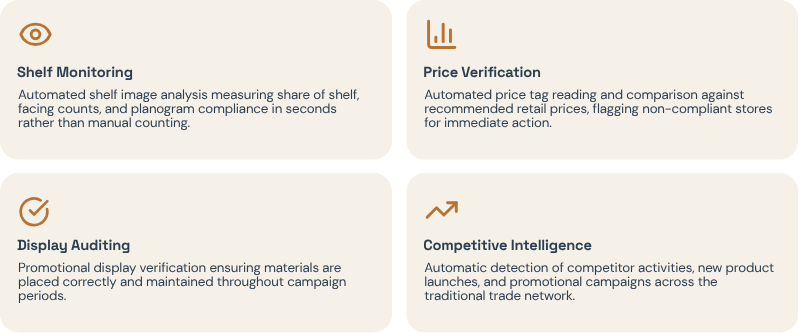
Image Recognition & Compliance Monitoring
AI-powered image recognition technology is transforming how brands monitor execution quality across traditional trade:
The Technology Multiplier
The combined effect of digital route management, real-time ordering, image recognition, and digital payments creates a multiplier effect. Each technology reinforces the others—better routing means more store visits, more visits mean more data, more data enables better AI recommendations, and better recommendations drive higher order values. The result is a virtuous cycle of continuous improvement.
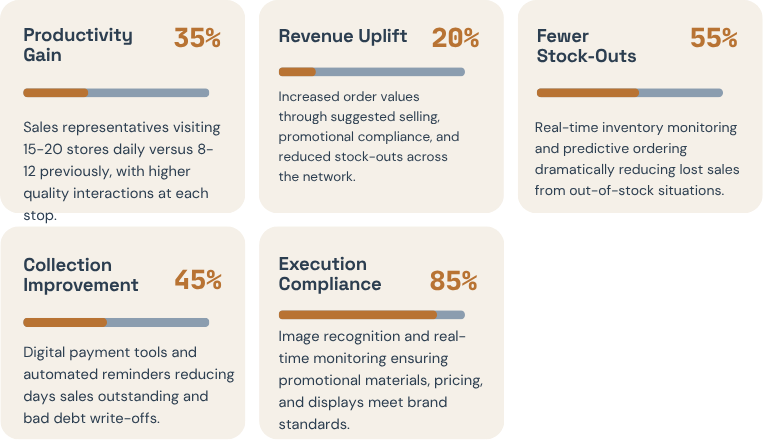
Measurable Results
Brands and distributors implementing comprehensive traditional trade modernization programs are achieving transformative results across key performance metrics:
Implementation Framework
Successful traditional trade modernization requires a phased approach that balances technology deployment with organizational change management. Based on our experience across the GCC, we recommend a four-phase framework:
01
Foundation: Data & Infrastructure (Months 1-3)
Begin with comprehensive store census and classification. Deploy mobile devices and connectivity to field teams. Establish baseline KPIs for productivity, coverage, and sales performance.
02
Digitization: Core Processes (Months 3-6)
Implement digital order capture replacing paper-based systems. Deploy dynamic routing algorithms optimizing daily visit plans. Introduce digital payment collection and automated invoicing.
03
Intelligence: Analytics & AI (Months 6-12)
Deploy image recognition for automated shelf and compliance monitoring. Implement AI-powered suggested ordering based on historical patterns. Build real-time dashboards providing visibility to all stakeholders.
04
Optimization: Continuous Improvement (Months 12-18)
Refine algorithms based on accumulated data and performance feedback. Expand coverage to new geographies and store segments. Integrate with broader supply chain and trade promotion systems.
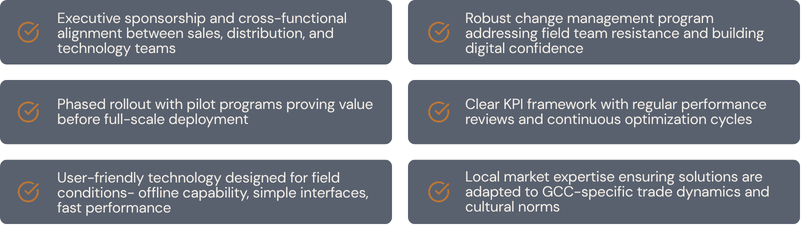
Critical Success Factors
Future Outlook
The modernization of traditional trade in the GCC is still in its early stages, with significant opportunity ahead. Several emerging trends will shape the next phase of evolution:
B2B E-Commerce Platforms
Digital wholesale platforms enabling traditional retailers to order directly from brands and distributors, bypassing traditional sales force models for routine replenishment.
Last-Mile Integration
Traditional trade stores becoming micro-fulfillment centers for quick commerce platforms, leveraging their neighborhood proximity for ultra-fast delivery.
Embedded Finance
Fintech solutions providing working capital loans, insurance, and financial services to traditional retailers based on transaction data and digital credit scoring.
AI-Powered Personalization
Machine learning algorithms personalizing assortment recommendations, pricing strategies, and promotional offers for individual stores based on local demand patterns.
Traditional trade will not disappear. It will evolve. The bakala of 2030 will look very different from today: digitally connected, data-enabled, financially included, and seamlessly integrated into omnichannel distribution networks.
Traditional trade modernization is not a technology project—it’s a business transformation.
The brands and distributors that recognize this distinction—investing in people, processes, and culture alongside technology—will unlock the full potential of the GCC’s most resilient and pervasive retail channel. With the right partner and the right approach, traditional trade can become your most profitable growth engine.